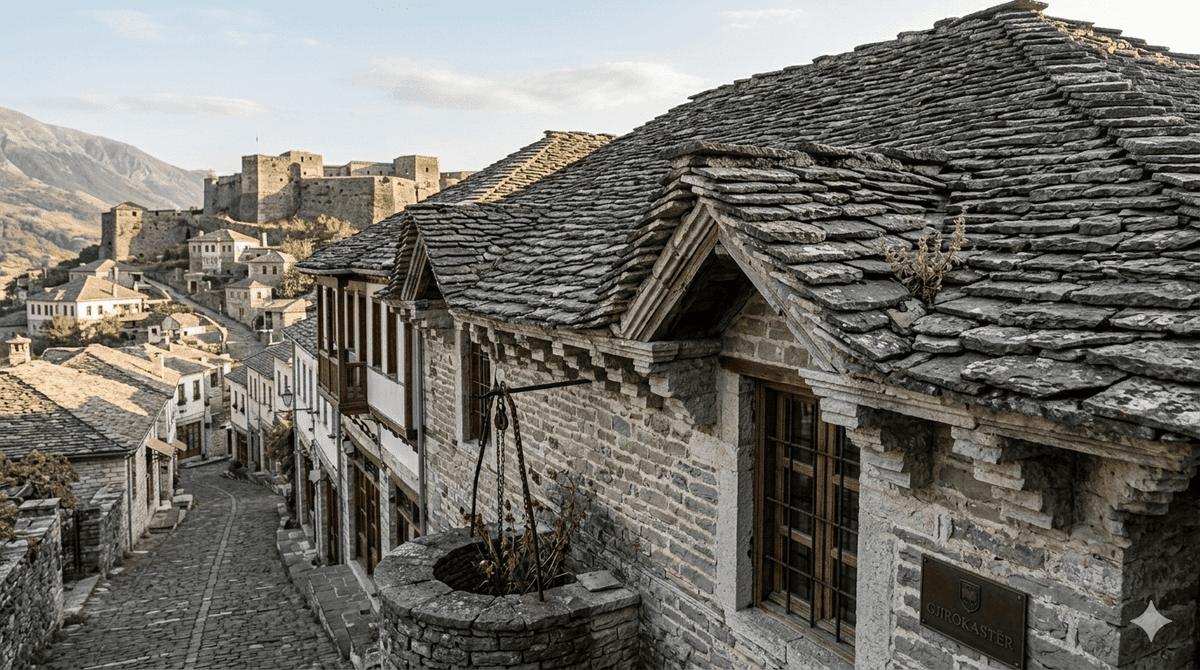
The Man Who Holds the Stone Together
Arjan's workshop smells like dust and cold metal. He is sharpening a chisel when I sit down.
VoyZee: How did you start doing this work?
My father was a mason. I started carrying tools for him when I was 14. For the first few years, that was all I did — carry things and watch. He didn't let me touch a roof until I was 24. He said if I made a mistake up there, the whole family would know about it for 50 years.
VoyZee: How does the stone stay in place without mortar?
Interlock. Each slab overlaps the one below it, and the one above holds it down by weight. Gravity does all the work. But if one stone is cut wrong — even a little — the row shifts. Give it 10 years, 20 years, and the whole roof starts to slide. You can't see the mistake at first. You only see it when it's already too late.
VoyZee: Walk me through your morning on a job day.
I'm up at five. In summer you have to be on the roof by seven, eight at the latest. By noon the stone is too hot to touch with bare hands. I carry the slabs up myself — sometimes 30 kilograms on my back, up a ladder. There's no machine that does this part. There never was.
VoyZee: What do you think of the new hotels going up in the city?
The work is good. I don't complain about money. But some of these developers, they use factory-cut stone panels. Thin. Fake-looking. They glue them to concrete and call it traditional. It looks like Gjirokastër the way a photograph looks like a person. I don't say this to them directly. But I think it every time I walk past.
VoyZee: Why is this place called the City of Stone?
Because everything here comes from the same mountain. The streets, the walls, the roofs, the old fortresses — one source. People here didn't build with stone. They carved themselves a space inside it. We don't sit on top of this landscape. We live inside it. That's the difference between this city and every other city in Albania.
VoyZee: Do you have any apprentices?
No. I had one boy, maybe eight years ago. He lasted one summer. Now he works in an office in Tirana, I think. The young ones go to Tirana, or they go to Germany. I don't blame them — office work pays the same and your knees still work at 50. Right now I know of four masons in this city who can do what I do. Four. Two of them are older than me.
VoyZee: What do tourists miss when they walk through the Old Bazaar?
They look at the souvenir shops. They look at the cobblestones because someone told them to. But they never look up. The eaves on these buildings — the way the stone steps out in layers under the roofline — that's the work. That's where you can see if a mason knew what he was doing or not. Nobody looks. I stopped being annoyed about it. Now I just notice.
VoyZee: What happens to these roofs when you and the others retire?
They will use concrete. Or they'll put some material underneath that looks close enough and hope the tourists don't know the difference. The roofs that exist now will last another hundred years if someone maintains them. But when they need rebuilding — real rebuilding — there will be no one. UNESCO can protect a building on paper. It cannot protect the knowledge inside a man's hands. That knowledge just ends. It ends with us.

Written by VoyZee Team
Official VoyZee editorial team
